IRM Awards 4th Elaine Redding Brinster Prize to Mary-Claire King, PhD
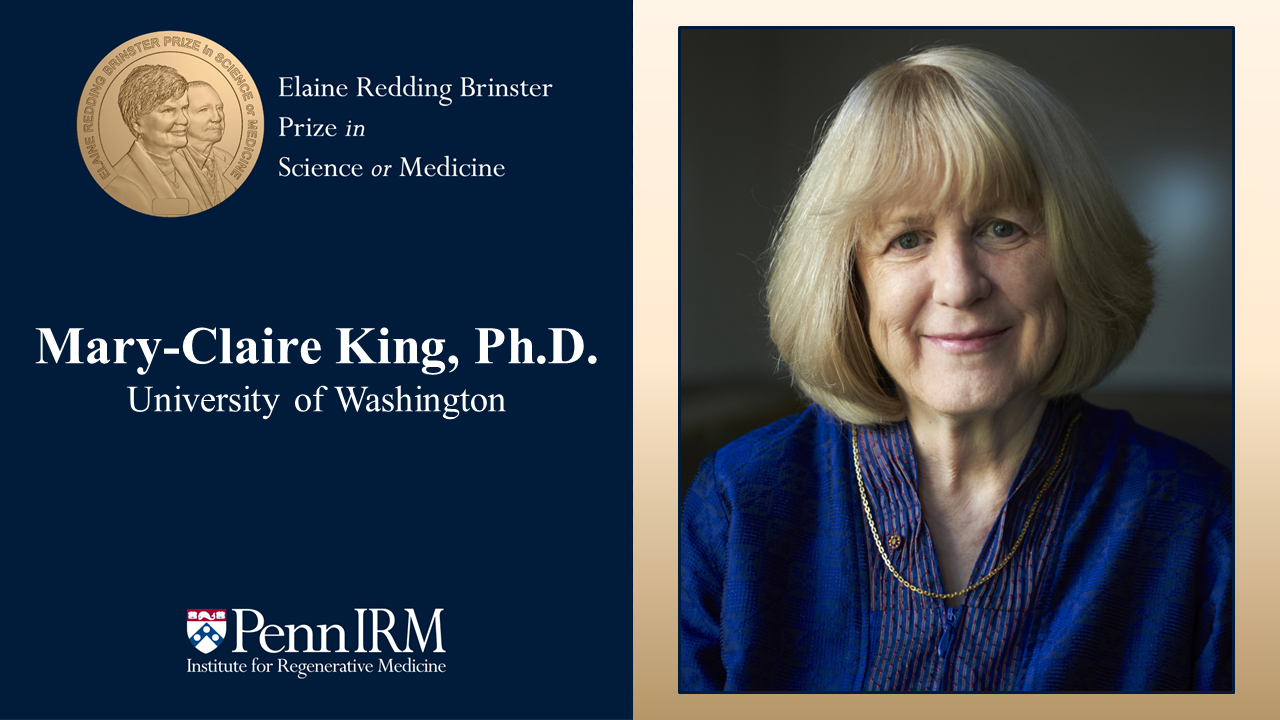
Recognized for her discovery that variant forms of the BRCA1 gene impact hereditary breast cancer, the Institute for Regenerative Medicine at the University of Pennsylvania has awarded Mary-Claire King, PhD the fourth Elaine Redding Brinster Prize in Science or Medicine. Dr. King proved the existence and precise location of variants of the BRCA1 gene responsible for inherited predisposition to breast and ovarian cancer, which represented a major advance in our understanding of both these cancers and the genetics of complex human traits.
“Dr. King mapped the BRCA1 and BRCA2 genes as causal for human breast and ovarian cancers. While we now take for granted using genetic variation to predict possible disease predisposition, Dr. King’s research led to the first commonplace test for predisposition to cancer. Dr. King also used her genetic acumen to develop genetic tests for human rights abuses and forensic applications by the United Nations. Dr. King has had an extraordinary career, transforming her basic science discoveries into practices for humankind,” said Ken Zaret, PhD, director of Penn’s Institute for Regenerative Medicine and the Joseph Leidy Professor of Cell and Developmental Biology in the Perelman School of Medicine. “The Brinster family and the IRM are thrilled to award Dr. Mary-Claire King the 2025 Elaine Redding Brinster Prize in Science or Medicine.”
The prize, supported by an endowment from the children of Elaine Redding Brinster, is awarded annually to a researcher whose singular discovery has made a unique impact on biomedicine. This year, the Brinster family is happy to announce from this year forward, the winner will receive $200,000, a commemorative medal, and an invitation to present a ceremonial lecture at the University of Pennsylvania. Dr. King will accept the prize March 12, 2025, as part of the day-long Ralph L. Brinster Symposium. The symposium will feature several eminent speakers from across the biomedical sciences, including Jay Shendure, MD, PhD, of the University of Washington; David C. Page, MD, of the Massachusetts Institute of Technology; Michael Rosbash, PhD, of Brandeis University; and Li-Huei Tsai, PhD, of the Massachusetts Institute of Technology.