
Neurulation of the cynomolgus monkey embryo achieved from 3D blastocyst culture
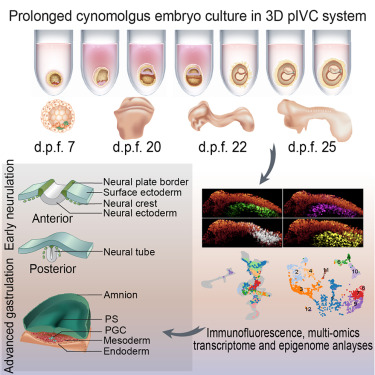
A joint collaboration between the Plachta Lab, led by Nicolas Plachta, PhD, the William Richard Gordon President’s Distinguished Professor in Genetics, at the the Perelman School of Medicine at the University of Pennsylvania and the Chinese Academy of Sciences found that understanding human post-implantation development remains a primary challenge due to restrictions on human embryo research, technical limitations of prolonged embryo culture, and inaccessibility to tissue. The study used a 3D prolonged in vitro culture system that supports monkey embryo development up to 25 days postfertilization. This extends primate embryo culture to allow for the study of embryogenesis through advanced gastrulation and early neurulation.
Highlights of the study include:
- Cynomolgus blastocysts are cultured to d.p.f. 25 within an optimized 3D system
- Cultured embryos recapitulate developmental features of their in vivo counterparts
- Early neurulation features are demonstrated in cultured embryos
- Epigenetic features of three germ layers in primate are unveiled in cultured embryos
Read the full paper, as published in Cell, here.